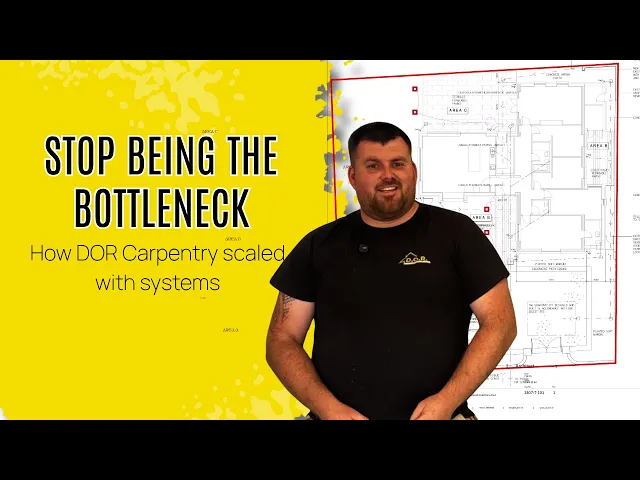
Blog details
Our stories dive deeper into construction trends, expert insights, and real-world project experience.
Case Study: How DOR Carpentry Scales Without the Owner Being the Bottleneck
From the family trade to his own firm
Some builders fall into the trade. Darren O'Reilly was raised in it.
"From a young age I was always building — with the uncle, with my grandfather, with my father," he says. By the time he qualified through his apprenticeship in 2014 and went out on his own, he'd spotted a gap in the market for attic conversions. That niche became the foundation of DOR Carpentry & Building Services.
The early years were built on two things: doing right by customers, and not burning bridges. Darren started out subbing for an established builder, Derek of Divine Building Services, who gave him the chance to work a few days a week while he found his own feet.
He taught me an awful lot, and he gave me the opportunity to work two or three days a week with him while I went out by myself — that was a massive step.
That ethos still runs the business today. "We were customer-focused at the start, we got a good break — and we capitalised on it." A two-hour drive to an early job they couldn't turn down led to another, and another. Within six or seven months the calendar was full a year ahead.
Today DOR keeps everything in-house — office staff, a workshop, and a brand-new office.
Building a brand, not just a business
Ask most builders how they win work and they'll talk about word of mouth. Darren has turned that instinct into a 25,000-strong audience.
It started, fittingly, in a pub. His partner Karen's friend Kira — who ran interiors brand Eagan Interiors — pushed him to set up an Instagram account one night. "I woke up, threw a few pictures up, got the hang of it, and it's grown to twenty-five or twenty-six thousand over the last couple of years."
What makes it work isn't polish — it's honesty. DOR shows the whole job: the start, the middle, the end. What goes right, and what goes wrong.
We share a few tips, and it's a great community. I've met an awful lot of other builders through it. And clients have watched us on social media — they show up saying 'I know the lads already, I know James, I know Ryan' — without ever having met them.
That familiarity shortens the distance between a first enquiry and a signed job. The audience isn't a vanity metric; it's a pipeline.
The next chapter: systems, not bottlenecks
For all the growth, Darren is clear-eyed about what holds builders back as they scale — and it isn't a shortage of work. It's the owner becoming the single point everything runs through.
"The thing with me would have been: it's my way or no way," he admits.
His answer is to put proper systems behind the business so his team can take ownership — and so he's freed up to be where he's needed most. That's where Assemble Pro comes in.
What I'm trying to implement are the systems in the back office that the office staff can run — and that allows me to control the work on site. With Assemble Pro the lads can pull their own costs and material list for the day, instead of everything being held up waiting on me. I think that's going to be a big thing.
Hours back, starting with blockwork
The clearest example is the job nobody enjoys: quoting blockwork. It's slow, fiddly, and easy to get wrong. With Assemble Pro it's become one of the fastest parts of Darren's week he runs a quick measurement off the plan and the software spits out the materials.
On blockwork alone, that's hours saved every week before you count everything else it speeds up.
That time doesn't just disappear into faster quotes, either. The marked-up plans go straight to clients and to his own crew, so everyone can see exactly what's needed.
Sending the marked-up plans to clients or even my own team cuts out the miscommunication. By the time they get to site, everyone's ready to start.
One source of truth, from estimate to site
The plan doesn't stop at the office. Darren is connecting Assemble Pro across the whole chain his quantity surveyor and his suppliers included so there's a single source of truth from estimate to site.
He sees that alignment as the thing that prevents most on-site friction. As he puts it, problems rarely come from someone setting out to do the wrong thing they come from two people picturing two different plans. Put the system in the middle, and that gap closes.
There's a people benefit too. "The office staff want a bit more responsibility they don't want to be checking everything down with me. If they've got the systems in place, it flows much easier. It makes life an awful lot easier for everyone."
Why it matters
Darren's story is a template for the modern trade business: built on craft and relationships, grown through an authentic online presence, and now scaled through systems that let good people do their jobs without the founder in the middle of every decision.
DOR isn't adopting technology for its own sake. It's adopting it so Darren can step back from the bottleneck and so his team, his QS and his suppliers can all read off the same sheet.
It makes life an awful lot easier for everyone.
Frequently Asked Questions
How is DOR Carpentry using software to scale the business?
DOR Carpentry uses Assemble Pro to put systems behind the back office so office staff and crews can pull their own costs and material lists, freeing owner Darren O'Reilly from being the bottleneck on every job.
How much time does Assemble Pro save on blockwork takeoffs?
Darren O'Reilly runs a quick measurement off the plan and Assemble Pro generates the material list automatically. On blockwork alone it saves him hours every week, before counting everything else it speeds up.
How do marked-up plans reduce miscommunication on site?
Sending Assemble Pro's marked-up plans to clients and the crew means everyone can see exactly what's needed. By the time the team reaches site they're ready to start, which cuts out costly misunderstandings.
How can a builder stop being the bottleneck in their own business?
By setting up shared systems so the office, quantity surveyor and suppliers all work from a single source of truth. Everyone reads off the same sheet, the team takes more responsibility, and the owner is freed to focus on site.

