Blog details
Our stories dive deeper into construction trends, expert insights, and real-world project experience.
Construction Tech, Subbie Risks & the Future of AI – A Chat with Patrick from Fiable
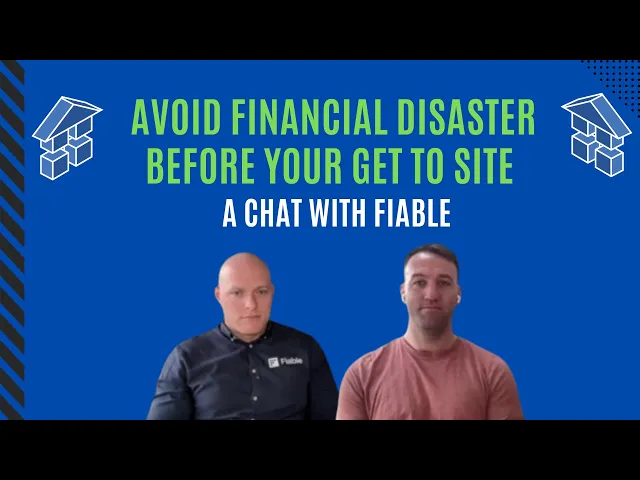
I recently sat down with Patrick Conley, the founder and CEO of Fiable, for what turned out to be a cracking chat about the construction industry. Patrick and I first crossed paths years ago in Sydney’s construction tech scene, and since then I’ve kept an eye on his progress. He’s built a serious platform helping main contractors get a handle on subcontractor risks and financial viability.
This conversation really opened up on where the industry is at today, what challenges subcontractors are facing, and where technology (especially AI) is taking us. If you want to watch the full interview head over to our YouTube Channel and check it out
.
Subcontractor Risks: The Elephant in the Room
If you’ve spent any time on a job site, you’ll know the biggest risk usually isn’t the concrete pour or the crane lift – it’s the subcontractor’s ability to finish the job.
Patrick explained it well: many subbies are great at their trade, but not necessarily running a business. They’ll take on work without really crunching whether they’ve got the financial capacity to deliver. Add in material price spikes and slow payment terms, and suddenly you’re juggling bills and hoping the dominoes don’t fall.
One red flag Patrick called out? Unpaid tax obligations. The tax man is often the last in line to get paid, so if those debts are building up, it’s usually a sign something isn’t right.
I’ve seen it firsthand. My co-founder Keith once got burned for $60–80k by a larger subcontractor. He’d already fronted the material costs, and when the payment didn’t come, it nearly sank his business. Stories like that are all too common.project from start to finish.
Financial Viability: Prevention is Better than Cure
Patrick’s view is clear: “Prevention is better than cure.” Spending a bit upfront to assess subcontractors’ financial viability can save enormous headaches later.
Here’s a scary stat he dropped: every time a subcontractor fails mid-project, it costs on average 4x the original contract value to complete. Think about that on a multimillion-dollar job – it can wipe out a builder’s entire margin for the year.
The better approach? Spot problems early. And if things do go sideways, work with the subcontractor to get them through – whether that means advanced payments, helping with labour, or covering materials directly.
Advice for Newcomers: Get Your Hands Dirty
One thing I loved from the chat was Patrick’s advice for anyone starting out in construction:
Get your hands dirty. Try as many roles and project types as you can – you don’t know what niche you’ll love until you’ve been there.
Work hard and keep the right attitude. It still counts for everything in this industry.
Find a mentor. Having someone who’s been there before to give you a nudge in the right direction is a safe bet.
Solid, no-nonsense advice.
Tech & AI: The Future of Construction
We couldn’t finish without talking about technology and AI. Construction is often seen as the last bastion of the analog world, but change is finally happening.
Patrick’s already seeing main contractors hire internal AI leads to make sense of their own data. That’s huge. Big data and AI are moving from buzzwords to actual job titles in construction companies.
What’s next? Patrick reckons the future isn’t one “all-in-one” tool. Instead, it’ll be lots of point solutions that integrate – each one solving a specific problem but talking to each other seamlessly.
Give it ten years and hopefully we’ll be off spreadsheets and onto something smarter. Who knows, maybe even robots on site doing the framing and bricklaying (while we all enjoy universal basic income – wouldn’t that be nice?).
Where Fiable is Heading
Patrick and his team at Fiable have already landed about 75% of Australia’s top 20 builders. They’re building a serious moat around subcontractor financial data and risk insights.
Right now, they’re focused on expanding the platform at home, but they’ve got one eye on North America and the Middle East too. With the growth of data centres, residential towers, and big infrastructure, it’s an exciting time to be in their space.
Final Thoughts
This was one of those conversations that reminds me why I love this industry. Yes, construction has its challenges – subbie risks, tight margins, slow tech adoption – but with people like Patrick pushing forward, there’s a lot to be optimistic about.
If you’re a subcontractor, builder, or just someone curious about where construction is heading, give the full episode a listen. You’ll come away with practical advice and a good sense of where things are going next.
