Blog details
Our stories dive deeper into construction trends, expert insights, and real-world project experience.
Material Takeoffs for Roofing Contractors: Why They Matter and How to Get Them Right
You won the bid. Materials show up on site. And you’re three squares short.
Now you’re burning daylight waiting on a supplier run, your crew’s standing around, and the margin you quoted just got thinner. All because the takeoff was rushed or worse, eyeballed.
If you’re a roofing contractor still working off printouts and a scale ruler, or quoting from gut feel and experience alone, this one’s for you.
You can check out Assemble’s on screen takeoff and estimating system by signing up to a 14 day free trial (no credit card required) and upload your plans to start your first roofing takeoff today. www.assemblepro.com
What Is a Roofing Material Takeoff?
A material takeoff is the process of measuring your plans to figure out exactly what you need for the job and how much of it. For roofers, that means quantifying every component before a single shingle gets loaded onto the truck.
We’re talking roof area (adjusted for pitch), linear footage of hips and ridges, counts for vents, skylights, pipe boots, and everything in between. It’s the foundation of your estimate, your material order, and ultimately your profit.
Skip it or rush it, and you’re guessing. And guessing doesn’t scale.
What You Actually Need to Measure
Every roof is different, but a solid takeoff typically covers:
Area - The total surface area of the roof, adjusted for pitch. A 3/12 pitch and a 12/12 pitch on the same footprint produce very different square footage. Miss this and your shingle order will be off from the start.
Hips and Ridges - Linear measurements that drive your cap shingle and flashing quantities. These add up fast on complex roof lines.
Valleys and Eaves - More linear footage that affects your underlayment, drip edge, and ice-and-water shield requirements.
Counts - Skylights, vents, pipe boots, chimneys, dormers. Anything that interrupts the roof plane needs to be counted and accounted for. Each one affects flashing, sealant, and labour time.
Waste Factor - Most roofers add 10–15% for waste, but the actual number depends on the roof’s complexity. A simple gable needs less buffer than a cut-up hip roof with multiple penetrations.
Why Accurate Takeoffs Actually Matter
It’s tempting to think of the takeoff as admin work, something you rush through to get to the real job. But the takeoff is the job, at least the financial side of it. Here’s what’s at stake.
You stop over-ordering. Leftover bundles sitting in your yard aren’t inventory, they’re dead money. Accurate takeoffs mean tighter orders, less waste, and more cash in your pocket at the end of the job.
You stop under-ordering. Nothing kills momentum like a mid-job material run. Your crew’s idle, the homeowner’s watching the clock, and you’re eating the cost of a rush delivery. One accurate takeoff prevents all of that.
Your bids get sharper. When you know your quantities are right, you can bid with confidence. You’re not padding the quote to cover uncertainty, and you’re not leaving money on the table to win work. You’re pricing the actual job.
You look like a professional. General contractors and homeowners notice when a roofer shows up with a detailed, itemized breakdown. It builds trust and trust wins repeat business.
The Problem With “How We’ve Always Done It”
A lot of roofing contractors still do takeoffs the old-fashioned way. Print the plans, grab a scale ruler, and start measuring by hand. Or skip the plans entirely and measure on site.
It works…… until it doesn’t.
Hand measurements are slow and prone to error, especially on complex roofs with multiple pitches. On-site measurements mean you can only quote after a site visit, which limits how many bids you can turn around in a week. And paper plans don’t automatically calculate pitch adjustments, hip lengths, or total counts, that’s all mental math and manual tallying.
The contractors who are growing right now are the ones who’ve moved their takeoffs on-screen. They’re measuring directly from PDF plans, applying pitch factors automatically, and getting totals in minutes instead of hours.
Taking Your Takeoff Digital
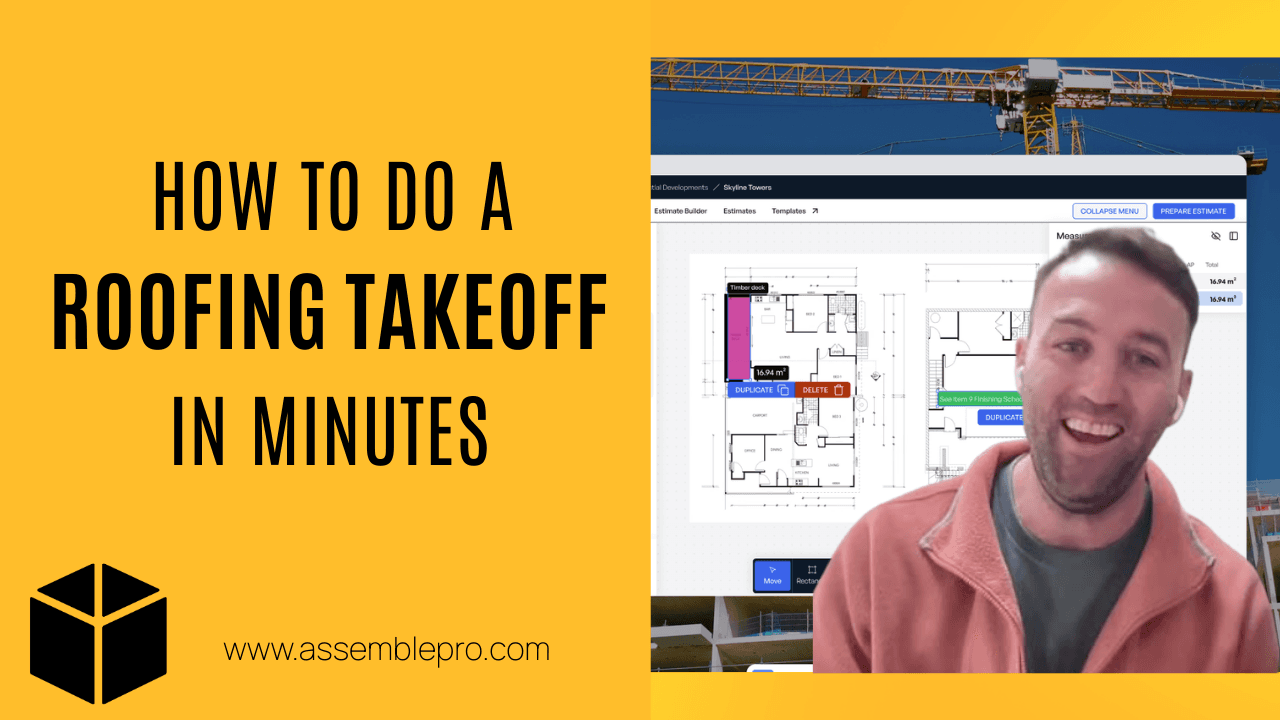
An on-screen takeoff lets you measure areas, lengths, and counts directly from your digital plans. You upload the PDF, set the scale, and start clicking. The software handles the maths including pitch adjustments and keeps a running tally of everything you’ve measured.
The whole process takes minutes. And you can do it from your office, your truck, or your kitchen table at 9pm when you’re trying to get one more bid out the door.
Pitch Matters More Than You Think
This is where a lot of roofing takeoffs go wrong. The plan view of a roof shows you the footprint the horizontal projection. But you’re not installing materials on a flat surface. You’re installing them on a slope.
A roof with a 4/12 pitch has about 5.5% more surface area than its footprint. Go up to an 8/12 pitch and you’re looking at about 20% more. On a large residential job, that difference can be thousands of dollars in materials.
Any decent takeoff process needs to account for pitch — either manually with a multiplier table or automatically through software that lets you apply pitch to each measurement.
From Takeoff to Estimate
A takeoff gives you quantities. An estimate gives you a price. The bridge between the two is your cost library, the unit prices, labour rates, and markup percentages that turn square footage into dollars.
The fastest roofing contractors have this dialled in. Their takeoff feeds directly into their estimate, so the moment the last measurement is placed, they’ve got a bid-ready number. No re-keying data, no spreadsheet gymnastics. Just quantities in, price out.
If you’re still copying numbers from one sheet to another, that’s where the errors creep in and where you’re losing.
Frequently Asked Questions:
What is a roofing material takeoff?
A roofing material takeoff is the process of measuring construction plans to determine the exact quantities of materials needed for a roofing job including shingles, underlayment, flashing, ridge caps, vents, and other components. It’s the first step in producing an accurate estimate.
How do you calculate roof area from plans?
You measure the footprint area from the plans, then apply a pitch multiplier to get the true surface area. For example, a 4/12 pitch uses a multiplier of approximately 1.054. Most on-screen takeoff tools apply this automatically when you input the pitch.
What’s the difference between a takeoff and an estimate?
A takeoff measures quantities, how much material you need. An estimate assigns costs to those quantities, how much the job will cost. The takeoff feeds the estimate. Without accurate quantities, your pricing will be off.
Why is pitch important in a roofing takeoff?
Pitch determines the true surface area of the roof. A steeper pitch means more material to cover the same footprint. Ignoring pitch leads to under-ordering materials, which causes delays and extra costs on site.
Can you do a roofing takeoff from PDF plans?
Yes. On-screen takeoff software lets you measure areas, lengths, and counts directly from PDF plans. You set the scale, trace the roof sections, apply pitch, and export your quantities all without printing a single page.
How long does a roofing takeoff take?
It depends on the complexity of the roof, but a straightforward residential takeoff using on-screen software can be done in 10–20 minutes. By comparison, manual methods using printed plans and a scale ruler can take an hour or more.
How much waste should I allow for roofing materials?
A common rule of thumb is 10–15%, but it depends on the roof. Simple gable roofs sit at the lower end. Complex roofs with hips, valleys, and multiple penetrations should be closer to 15% or higher.
Ready to take the guesswork out of your next takeoff? Get started with Assemble and see the difference accurate quantities make on your bottom line.