Blog details
Our stories dive deeper into construction trends, expert insights, and real-world project experience.
How contractors can protect their margins from rising construction costs in 2026
Prices are moving fast right now, and many builders are caught in a tough spot: locked into a fixed price they quoted before the latest wave of increases hit.
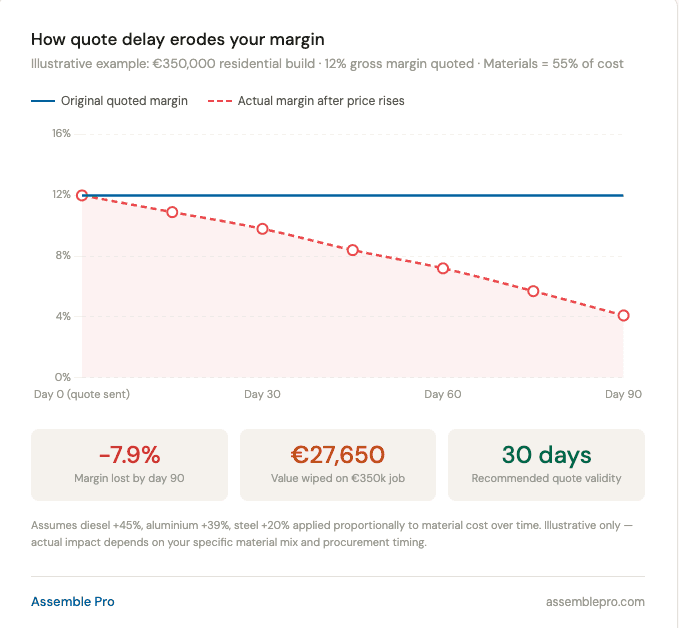
This isn't an abstract risk. If your materials make up 55% of a job's cost, which is typical on a new build and those materials have moved by 20 to 45%, you're looking at a significant chunk of your margin disappearing before you've laid a single block. On a $500,000 house, that can easily mean the difference between a profitable job and one you're working for nothing.
The good news is that there are concrete steps you can take right now, whether you're in the middle of a job, already submitted a quote, you're about to, or you're thinking about how to price work going forward.
Why this matters more for residential builders and sub contractors
Large commercial contractors have mechanisms for this. Their contracts often include escalation or "rise and fall" clauses that allow them to claim additional costs when commodity prices move beyond a set threshold. They have index references, formal notice procedures, and procurement teams who track this stuff.
As a residential builder, you have none of that. You give a homeowner a number, they say yes, you shake hands. The client isn't interested in commodity markets they just want their home built for what you told them. That's not unreasonable on their part. But it means the entire risk of a moving market sits with you. And in a market moving as fast as this one, that risk is significant.
Mid-job: what to do when prices move on a job you're already on
You've signed the contract, you've started on site, and material costs have moved since you priced the job. What can you actually do? The honest answer is that your options depend on how well you documented things at the start. But there's more room to act than most builders realise.
First: go back to your contract and read it carefully
Most residential builders sign a standard form contract without reading every clause. Now is the time to read it. Look for anything that mentions price variations, provisional sums, or PC items. These are your footholds.
Provisional sums and PC items are allowances built into a contract for items where the final cost wasn't known at signing.0 Things like fixtures, fittings, or specialist materials. If your contract includes them, and the actual cost has come in higher due to price rises, you have a legitimate basis to claim the difference. That's not a renegotiation, it's how those clauses are designed to work.
Second: document everything from here forward
If you haven't been keeping records of your material invoices against what you originally priced, start now. Every delivery docket, every supplier invoice, every quote revision you've received since you started the job. This paper trail is what turns a difficult conversation with a client into a factual one.
The moment you have supplier evidence showing that steel, timber or diesel has moved materially since your contract date, you have something concrete to put in front of a client. Without it, you're asking them to take your word for it.
Third: raise it early, not at the end
The worst thing you can do is say nothing until the final account. By that point the client has mentally moved on, the goodwill has faded, and a cost increase feels like an ambush. If you can see a problem developing, a specific material that's moved significantly and is still to be ordered, raise it now, as a heads up, before you've incurred the cost.
Frame it as looking out for them: "I wanted to flag before I place this order that the price has moved since we agreed the contract. Here's what I quoted, here's what I'm being charged now. How would you like to handle it?"
Most reasonable clients, given early notice and clear evidence, will find a way to work with you. The ones who won't are the ones who feel blindsided.
Fourth: look at what's still to be ordered
You may not be able to recover cost on materials already purchased, but anything still to be procured is still within your control. If you have significant structural or finishing materials still to order, get supplier quotes locked in immediately, even if you're not ready to order yet. A fixed quote, even for 30 days, gives you certainty on that portion of the job.
Some suppliers will hold a price for a short window if you explain the situation. It's worth asking, because locking in even part of your remaining spend reduces your exposure from here.
Finally: know when to take the hit and move on
Sometimes the numbers don't work out and there's no mechanism to recover the cost. If that's your situation, the most important thing is to understand exactly how much you're absorbing, finish the job well, and make sure the next contract has the protections in place that this one didn't.
A job where you lose a bit of margin but deliver a great result is recoverable. A job where you lose margin, fall out with the client, and leave a bad reputation behind is a much bigger problem.
Three things to do on every job going forward
For any quotes you're preparing now, these three steps will significantly reduce your exposure in a volatile market.
1. Limit your quote validity to 30 days in writing
Most builders quote and leave it open indefinitely. Stop doing that. Put a 30-day validity on every quote and make it explicit in the document. Something like: "This price is valid for 30 days from the date of issue. Beyond that, key material costs will be reviewed before a contract is signed."
Clients will sometimes push back, or ask for 60 or 90 days. Hold firm on 30, especially right now. In a market moving at this speed, agreeing to hold a price for three months is a serious financial gamble.
2. Break out major material packages separately in your quote
Instead of a single lump sum, identify the major material packages on the job eg structural timber, roof covering, windows, insulation, blockwork and present them as separate allowances within your quote.
You don't need to produce a full bill of quantities. Just enough separation that if a client comes back six weeks later and wants to proceed, you can point to a specific line and say: "This allowance has moved. Here's the current supplier price versus what I originally quoted."
It's a far easier conversation than trying to renegotiate a bottom-line number.
3. Consider materials-at-cost for longer projects
For anything running six months or more, it's worth having an upfront conversation about how major materials are handled. Some builders are moving to a model where materials are passed through at actual invoice cost, with a fixed margin on top.
Clients can be receptive when it's framed honestly: "I'd rather be transparent with you about what things actually cost than build in a large contingency and hope the market doesn't move." Not every client will agree, but for the right project it removes commodity risk entirely.
You can only protect yourself on what you can see. And you can only see it if you estimated properly in the first place.
Why all of this depends on how you estimate
Here's the thing: the three steps above only work if your estimates are already broken down by cost type.
If you're quoting from a spreadsheet with a single number at the bottom or even a list of trade packages with no cost breakdown underneath you don't have the information you need when a supplier comes back with a revised price. You can't tell a client that your structural package has moved by a specific amount if you never separated it out in the first place.
This is a fundamental estimating problem, and it's one that many residential builders don't solve until they've been burned by it.
The builders who navigate rising costs best aren't the ones who are best at negotiating with clients after the fact. They're the ones who know their numbers well enough that the conversation never needs to become a renegotiation.
This is what Assemble was built for
Assemble Pro is a construction takeoff and estimating platform built specifically for small to mid-sized contractors. This will help you structure your estimate by labour, material, plant, and subcontract cost from the start not as extra work, but as how the platform works.
What that means in practice, in a market like this one:
See your exact material exposure on any job in seconds when prices move
Break out material allowances in quotes automatically, ready to present to clients
Price new work with confidence no guessing at contingencies
Build a consistent estimating process that protects you on every job going forward
Start your free trial at assemblepro.com
