Blog details
Our stories dive deeper into construction trends, expert insights, and real-world project experience.
What is a Quantity Takeoff? A Plain-Language Guide for Contractors
If you've ever written down every material you need before pricing a job, you've already done a takeoff. Here's what it actually means — and how to do it faster.
Quick Answer
A quantity takeoff (often shortened to QTO or just "takeoff") is a detailed list of every material, component, and item of work needed to complete a construction job — with exact quantities and measurements taken directly from the plans. It is the foundation of any accurate price. You do the takeoff first, then apply your rates to get your estimate.
What a Quantity Takeoff Actually Is
The term comes from "taking off" measurements from a set of drawings — literally lifting the numbers off the plans and turning them into a materials list. Before any pricing happens, someone has to answer the question: how much of everything do I need?
That answer is your takeoff.
A roofer doing a takeoff on a new build would measure every roof plane, calculate the total area, then work out how many tiles, how much underlay, how many metres of ridge cap, and how many boxes of fixings are needed. A framer would count every linear metre of wall plate, every stud, every nogging, every sheet of bracing.
Done properly, a takeoff means you order the right amount of material, you price the job accurately, and you don't get a nasty surprise when you're halfway through and you've run out.
Worth knowing: The word "takeoff" is used slightly differently in different markets. In Australia and the UK, contractors often say "quantity takeoff" or just "takeoff." In the US, "material takeoff" or "construction takeoff" is more common. They all mean the same thing.
Why It Matters More Than Most Contractors Think
Most experienced contractors know that underquoting kills a job faster than losing it. The root cause of most underquotes isn't pricing — it's measurement. The labour rate is fine, the margin is fine, but somewhere a wall area got missed, or a waste factor wasn't applied, and the job runs over.
A proper quantity takeoff protects you in three ways:
Accurate pricing. You can only price what you've measured. Guessing quantities, even from experience, introduces risk on every job.
Material ordering. A takeoff gives you an exact order list. Less overordering, less waste, no emergency supply runs mid-job.
Defending your quote. When a client pushes back on your price, a detailed takeoff shows exactly where every dollar comes from. It turns a negotiation into a conversation about scope.
Pro tip: The contractors who win on price most consistently aren't the cheapest — they're the most accurate. A tight takeoff lets you price confidently without padding your margin to cover uncertainty.Takeoff vs Estimate: What's the Difference?
These two words get used interchangeably but they mean different things — and the distinction matters.
Quantity takeoff — A list of materials and quantities measured from plans. It answers: how much of everything do I need?
Estimate — A cost calculation based on those quantities. It answers: what will this job cost?
Quote — A fixed price offered to the client. It answers: what will I charge for this job?
Bill of quantities (BOQ) — A formatted document listing quantities, descriptions, rates, and totals. Used for tendering or contracts.
The takeoff feeds the estimate. The estimate informs the quote. Get the takeoff wrong and everything downstream is wrong too.
What Goes Into a Quantity Takeoff
A takeoff lists materials in the units you'll actually buy or use them — square metres, linear metres, individual units, litres, tonnes. Here's what each measurement type covers:
Area (m²) — roofing, flooring, plastering, tiling, painting
Linear (lm) — skirting, cornices, wall plates, cables, pipe runs
Volume (m³) — concrete, excavation, fill material
Count (each/no.) — doors, windows, light fittings, fixings, downpipes
Weight (kg/tonne) — steel, reinforcement bar
Most takeoffs also include a waste factor — an uplift percentage to account for cuts, off-cuts, breakages, and the reality of working on site. Standard waste allowances vary by trade and material, but 5–15% is typical for most finishes work.
How to Do a Quantity Takeoff, Step by Step
Step 1 — Get the plans. You need the architectural or engineering drawings — either printed or as a PDF. The more complete and accurate the plans, the better your takeoff will be. If plans are missing detail, flag it before quoting.
Step 2 — Set the scale. Every drawing has a scale (e.g. 1:100). You need to know this to measure accurately. In takeoff software, you calibrate by clicking on a known dimension. On paper, you use a scale ruler.
Step 3 — Work through the plans systematically. Go room by room, or element by element. Don't jump around — you'll miss things. Some contractors work from left to right across the plan; others work by element (all walls, then all floors, then all ceilings).
Step 4 — Measure each element. For areas, trace or count. For linear items, measure the run. For individual items, count them. Note the unit for each item as you go.
Step 5 — Apply waste factors. Once you have net quantities, add your standard waste uplifts. Keep these consistent job to job so your pricing is predictable.
Step 6 — Compile and check. Organise your quantities into a clear list, then cross-check against the plans. It's worth a second pass — a missed wall or a wrong scale can cost you on a big job.
Step 7 — Apply your rates. Now the estimate begins. Take your quantities and multiply by your material costs and labour rates to get a total.Takeoffs by Trade — What You're Typically Measuring
Roofing: Roof area (m²), ridge/hip linear (lm), flashings, gutters. Watch out for pitch factor — a steeper roof has more actual area than plan area.
Timber framing: Wall plates (lm), studs (count), noggings, bracing sheets (m²). Door/window openings reduce stud count but add lintels and trimmers.
Plastering / drywall: Wall area (m²), ceiling area (m²), compound, corner beads (lm). Deduct openings but add reveals and returns.
Electrical: Cable runs (lm), conduit, fittings (each), board components. Allow for vertical drops and horizontal runs separately.
Painting: Wall/ceiling area (m²), litres per coat, number of coats. Different surfaces absorb paint differently — substrate matters.
Concreting: Volume (m³), reinforcement (kg), formwork (m²). Overorder slightly — short pours are expensive.
Manual Takeoffs vs Software: The Practical Difference
Most contractors started doing takeoffs by hand — paper plans, scale ruler, notepad, calculator. It works. But it's slow, and every manual step is an opportunity for a mistake.
Manual (paper or Excel):
Scale ruler on printed plans, or zooming in on screen
Measurements typed or written into a spreadsheet
Waste factors calculated manually
Easy to lose work, hard to update when plans change
Typical time: 2–8 hours for a standard residential job
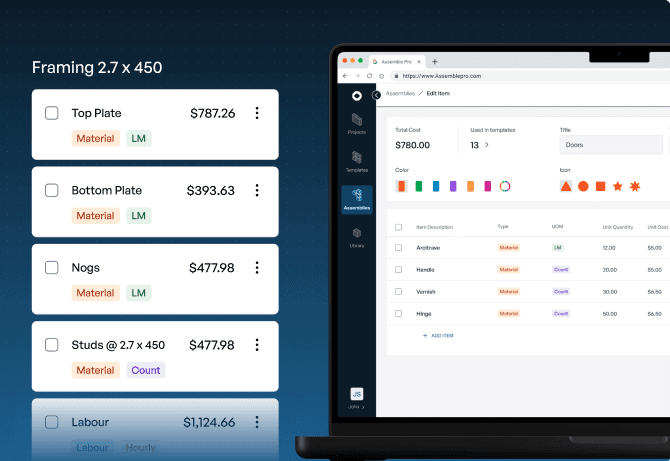
Takeoff software (like Assemble Pro):
Upload PDF plans directly — no printing needed
Click or trace to measure — software calculates area and linear automatically
Waste factors built into your item library
Quantities feed directly into your estimate
Typical time: 30–90 minutes for the same job
Pro tip: The time saving on takeoffs is real — but the bigger gain is accuracy. When you're measuring on screen from a calibrated PDF, you're not squinting at a scale ruler. The measurements are consistent every time.
Frequently Asked Questions
What is a quantity takeoff in construction?
A quantity takeoff (QTO) is a detailed list of every material, component, and item of work needed to complete a construction project — with exact quantities and measurements taken from the drawings. It is the foundation of any accurate cost estimate. The takeoff comes before pricing: you measure first, then apply rates.
What is the difference between a quantity takeoff and an estimate?
A quantity takeoff measures what is needed — it lists materials and quantities from the plans. An estimate applies prices to those quantities to calculate the total cost. The takeoff comes first and feeds directly into the estimate. You can't estimate accurately without a takeoff.
How long does a quantity takeoff take?
A manual takeoff for a residential job typically takes 2–8 hours depending on complexity and the contractor's experience. Using takeoff software can reduce this to 30–90 minutes for the same job, by automating measurements from PDF plans and eliminating manual calculation steps.
What trades need to do quantity takeoffs?
All trade contractors need takeoffs before pricing a job. Roofers measure roof area, tiles, underlay, and ridge caps. Electricians measure cable runs, conduit, and fittings. Framers count studs, plates, and bracing. Plasterers measure wall and ceiling area. Painters calculate litres per m² and number of coats. Concreters calculate volumes. Every trade has its own measurement approach, but the principle is the same.
Can I do a quantity takeoff from PDF plans?
Yes — and this is now the most common way contractors work. Modern takeoff software lets you upload a PDF of the drawings, set the scale by clicking on a known dimension, and then click or trace to measure areas, linear metres, and counts automatically. This is significantly faster and more accurate than scaling printed drawings by hand.
What is the difference between a quantity takeoff and a bill of quantities?
A quantity takeoff is the process of measuring and listing quantities from plans. A bill of quantities (BOQ) is the formatted document that results from that process — typically including item descriptions, units of measurement, quantities, rates, and totals. On smaller jobs, contractors often go straight from takeoff to estimate without producing a formal BOQ. On larger or tendered projects, a BOQ is standard.